How AI Tools Are Changing Cloud & DevOps Engineering Workflows (2026)
A practical overview of how AI tools like ChatGPT, Copilot, OpenClaw, Cursor, and Amazon Q are transforming Cloud and DevOps workflows, automation, debugging, and infrastructure development.
The Shift Toward AI-Assisted Cloud & DevOps Engineering
Over the past decade, Cloud and DevOps engineering have evolved rapidly. However, the past 12–18 months have introduced a significant shift due to the rapid adoption of AI-powered developer tools.
Engineers increasingly rely on tools such as:
- ChatGPT
- Claude
- GitHub Copilot
- Cursor
- Gemini Code Assist
- Amazon Q Developer
- n8n
- Zapier
- OpenClaw
- Replit Agents
These tools assist with learning, writing code, debugging systems, and automating workflows.
Rather than replacing engineering knowledge, AI tools are augmenting how engineers work with cloud infrastructure and distributed systems.
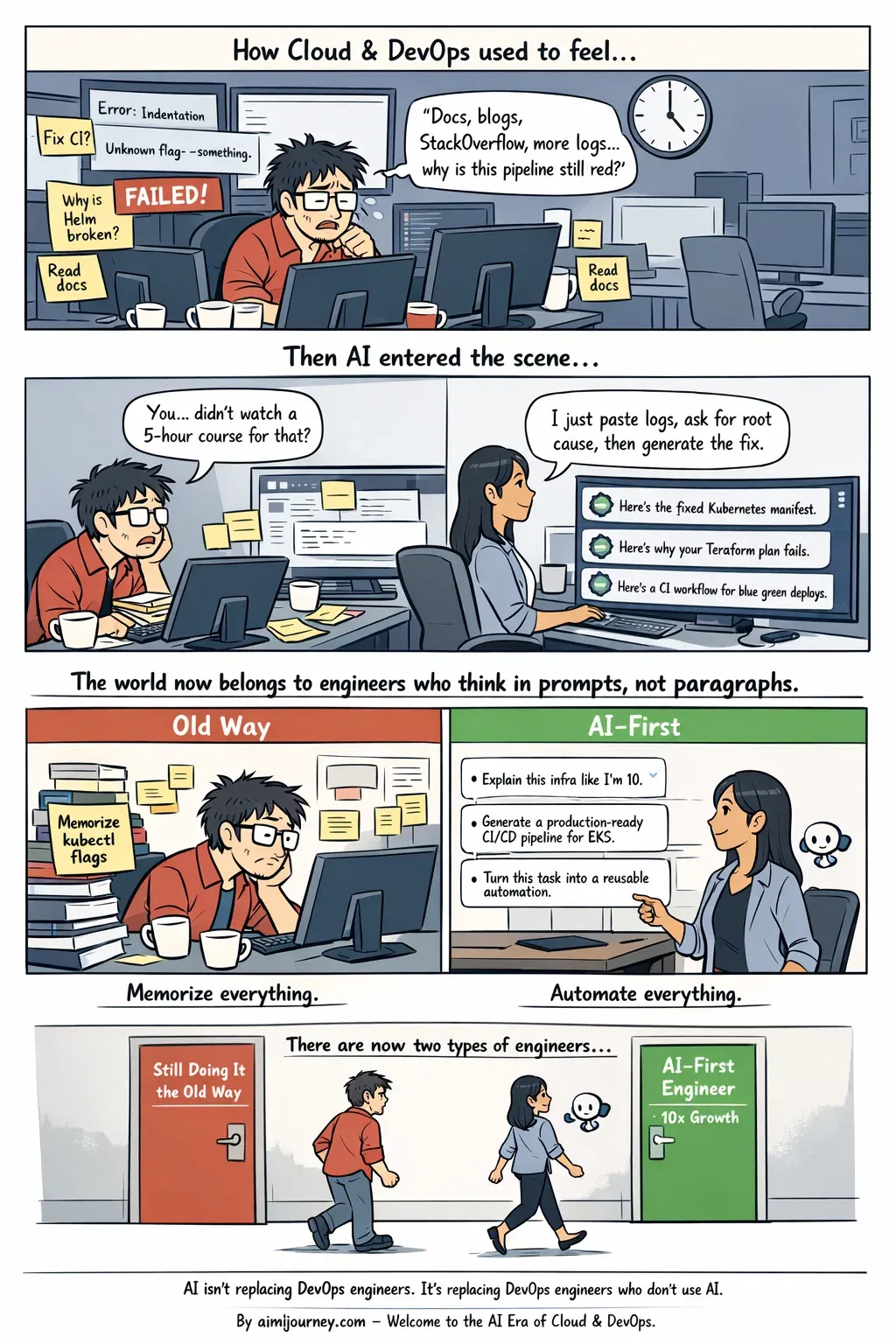
Traditional Cloud & DevOps Workflow
Historically, engineers relied heavily on manual processes.
| Engineering Task | Traditional Method |
|---|---|
| Learning new technologies | Reading documentation and completing online courses |
| Troubleshooting issues | Searching StackOverflow, forums, and community discussions |
| Infrastructure creation | Manually writing Terraform, CloudFormation, or YAML configurations |
| Pipeline debugging | Manual log analysis and trial-and-error debugging |
| Automation | Building custom scripts and integrations |
These workflows required significant manual effort and experimentation.
AI-Assisted Engineering Workflow
AI tools now assist at multiple stages of the engineering lifecycle.
Learn Concept
↓
Generate Infrastructure Code
↓
Deploy & Test
↓
Analyze Logs
↓
Automate Workflow
AI tools can help engineers analyze logs, generate infrastructure templates, and propose solutions faster than traditional methods.
Categories of AI Tools Used by Engineers
The ecosystem of AI developer tools continues to expand.
| Category | Example Tools | Purpose |
|---|---|---|
| AI Assistants | ChatGPT, Claude, Gemini | Explanations, research, and troubleshooting |
| AI Coding Tools | GitHub Copilot, Cursor, Claude Code | Code generation, refactoring, and development assistance |
| Cloud AI Assistants | Amazon Q Developer, Gemini Code Assist | Cloud architecture guidance and development support |
| Automation Platforms | n8n, Zapier, Make | Workflow automation and system integrations |
| AI Agents | OpenClaw, AutoGPT, CrewAI | Autonomous task execution and workflow orchestration |
These tools support engineers in coding, automation, infrastructure management, and troubleshooting.
The Emerging Role of AI Agents
A newer category of tools is AI agents, which go beyond answering questions.
AI agents can:
- execute commands
- interact with APIs
- automate workflows
- modify files or infrastructure
For example:
| Tool | Capability |
|---|---|
| ChatGPT | Provides explanations, troubleshooting guidance, and technical insights |
| GitHub Copilot | Suggests code snippets, functions, and infrastructure templates |
| OpenClaw | Executes tasks autonomously such as running commands and automating workflows |
This shift represents movement from AI assistants → AI systems capable of performing actions.
Engineering Workflow Evolution
The development workflow is gradually evolving.
Traditional Workflow
Research → Write Code → Debug → Deploy
AI-Assisted Workflow
Ask AI → Generate Code → Validate → Deploy
Engineers remain responsible for architecture decisions, validation, and operational reliability.
Skills Emerging in the AI-Assisted Engineering Era
As AI tools become part of engineering workflows, new skills are emerging.
| Skill | Description |
|---|---|
| Prompt engineering | Communicating effectively with AI tools |
| AI-assisted debugging | Using AI to analyze logs and identify root causes |
| Workflow automation | Designing automated pipelines and AI-driven workflows |
| System validation | Reviewing and validating AI-generated infrastructure or code |
Engineering expertise is still essential for system design, security, and production reliability.
Modern AI-Assisted DevOps Stack
Modern workflows increasingly integrate multiple layers of AI tooling.

This layered approach helps engineers reduce repetitive work and focus on higher-level system design.
Conclusion
AI tools are becoming a common part of the workflow for Cloud, DevOps, and infrastructure engineers.
They are helping engineers:
- learn technologies faster
- generate infrastructure templates
- troubleshoot systems more efficiently
- automate operational workflows
However, engineering knowledge remains essential for architecture design, validation, security, and reliability.
The combination of engineering expertise and AI-assisted workflows is likely to define how modern infrastructure systems are built and operated.